

Bridging Minds with Machines
The Path Where Neural Signals Meet Digital Intelligence
The Origins of the Human-Machine Connection
The idea of linking the human brain directly with machines once belonged to the realm of science fiction. Yet, neuroscience and engineering have gradually turned that dream into a frontier of modern science. The earliest foundations of this concept began with research into how neurons communicate through electrical impulses. Scientists discovered that thoughts, memories, and movements could be traced through measurable signals. Over time, this knowledge evolved into an understanding of how to interpret and translate these patterns into commands that computers can understand.
In the mid-twentieth century, early neurophysiologists used primitive electrodes to record brain activity in animals. Their goal was to map how sensory input translated into neural responses. What began as basic experimentation with brain waves eventually became the backbone of brain-computer interfaces, or BCIs. These systems are designed to capture brain signals, process them, and send them to external devices that respond in real time. By decoding the mind’s electrical symphony, scientists opened the door to communication beyond speech and movement, revealing a new dimension of human interaction with technology.
The Science Behind Brain-Computer Interfaces
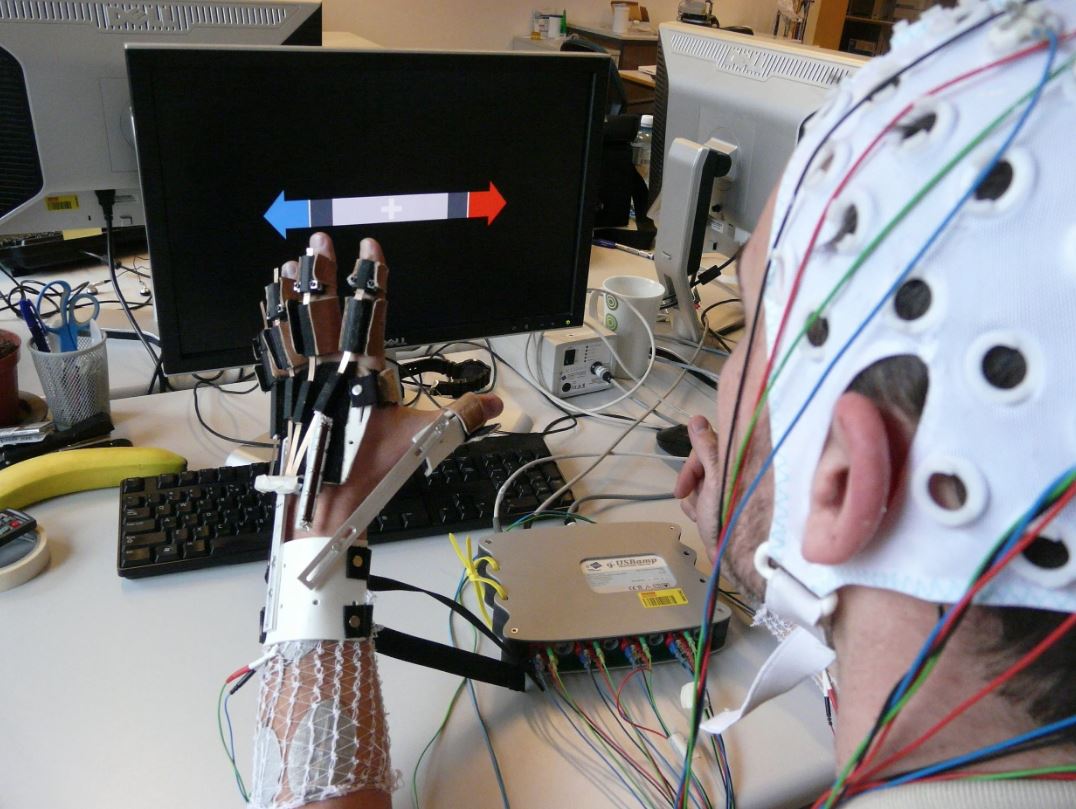
Brain-computer interfaces function by detecting, decoding, and converting electrical signals from the brain into usable digital commands. The process begins with the placement of sensors, which may be external, semi-invasive, or implanted directly into brain tissue. Electroencephalography, or EEG, remains one of the most common non-invasive techniques, as it measures brain activity through electrodes placed on the scalp. More advanced systems, such as electrocorticography, provide greater precision by reading signals directly from the surface of the brain.
The captured data undergoes complex signal processing to identify relevant patterns. Algorithms trained with artificial intelligence can distinguish between specific neural activities, such as imagining hand movements or focusing attention on particular stimuli. Once decoded, these patterns control external devices like robotic limbs, computer cursors, or even digital text generators. This direct communication pathway bypasses the body’s traditional neural network, giving individuals with paralysis or physical impairments a new means of interaction and independence. The technology continues to evolve toward higher accuracy, faster response times, and reduced invasiveness.
Applications Transforming Medicine and Society
Brain-computer interfaces have found their most immediate applications in healthcare. For patients with spinal cord injuries or neurodegenerative conditions, BCIs restore lost communication and mobility. A person unable to speak can now generate text through thought, while others can manipulate prosthetic limbs that respond as naturally as their biological ones once did. These systems work by interpreting the brain’s intention to move and transmitting the signal to the prosthetic in milliseconds, creating a seamless illusion of direct physical control.
Beyond medical rehabilitation, brain-machine technologies are entering new territories. Researchers are exploring how BCIs might enhance cognitive performance, memory, and focus. In the future, these systems could support learning by translating neural patterns into visual feedback, helping users refine their mental states for better problem-solving or emotional regulation. Military and industrial applications are also being tested, where workers or pilots could control machinery through neural input, reducing reaction time and increasing precision. The potential extends far beyond the clinical world, suggesting a transformation in how humans interact with information and machines.
The Role of Artificial Intelligence in Neural Decoding
Artificial intelligence has become an essential partner in the advancement of brain-computer interfaces. The human brain produces an immense volume of electrical activity every second, most of which is difficult to interpret without powerful computational assistance. Machine learning algorithms analyze these signals, identifying consistent patterns that correspond to specific thoughts, sensations, or movements. Over time, these systems learn to predict intentions with remarkable accuracy, making the connection between human and machine increasingly fluid.
Deep learning networks are particularly well suited for neural decoding. They process large datasets from brain recordings, improving their performance as more information becomes available. In some research environments, AI has been able to reconstruct visual images based on brain activity alone, capturing the essence of what a person is seeing or imagining. This blending of human cognition and artificial reasoning represents one of the most profound technological partnerships ever achieved. By merging organic and digital intelligence, researchers are laying the foundation for a new era of hybrid cognition.
Ethical and Philosophical Considerations
As brain-computer interfaces progress from laboratories into daily life, ethical questions grow in importance. Direct access to neural data raises concerns about privacy, consent, and autonomy. If technology can interpret thoughts, where does one draw the line between personal freedom and technological intrusion? Safeguarding mental privacy will become as vital as protecting digital data in traditional computing. Regulations must ensure that users maintain full control over their neural information and its use.
Philosophically, the fusion of mind and machine challenges traditional notions of identity and consciousness. When a thought can move a machine, or a digital system can interpret emotion, the boundaries between biological and artificial intelligence blur. The ethical use of such technology requires careful balance between empowerment and restraint. Scientists, ethicists, and lawmakers must work together to create frameworks that preserve human dignity while encouraging responsible innovation. The conversation surrounding this technology is as crucial as the science itself, as it defines how society will adapt to the next stage of human evolution.
The Future Landscape of Cognitive Technology
The horizon of brain-computer technology extends far beyond current applications. Researchers envision a world where thought-driven communication becomes commonplace, allowing people to connect directly from mind to mind through digital intermediaries. Such systems could revolutionize education, virtual reality, and human-computer interaction. Imagine entering a digital environment not with a keyboard or controller but through the simple act of thinking. This would make technology more natural, personal, and inclusive, especially for individuals with physical limitations.
Advances in nanotechnology, materials science, and wireless communication will further enhance BCIs. Flexible neural interfaces capable of long-term implantation without causing damage are already in development. Combined with cloud computing, these devices could transmit brain data securely for analysis, learning, and adaptive feedback. The ultimate goal is to achieve seamless integration between human cognition and artificial systems. This convergence represents both an opportunity and a challenge, as it redefines the nature of intelligence, connection, and human potential.
The Next Chapter of Human Evolution
The union of neuroscience and technology is not simply an innovation, it is an evolution of human capability. Brain-computer interfaces have moved from speculative fiction to scientific reality, opening a dialogue between thought and machine that reshapes what it means to be human. As research progresses, these systems may allow the mind to transcend physical barriers, enabling communication, control, and creativity in unprecedented ways. Each advancement brings humanity closer to a world where technology not only serves our needs but becomes an extension of our very consciousness.
Yet the future of this field depends on how wisely it is developed and governed. Balancing innovation with ethics will ensure that brain-computer interfaces enhance life without diminishing individuality. As science continues to map the language of thought, it invites a new understanding of intelligence that is collective, adaptive, and limitless. The next era of discovery will not just explore the universe outside us, but the uncharted cosmos within our own minds, where the boundaries between biology and technology begin to dissolve into one continuous stream of thought and possibility.